


Why Brighton Keep Winning the Transfer Market (and the Risks They Face)
- Abdullah Zubair

- Aug 10, 2025
- 4 min read
The recent links between Carlos Baleba and Manchester United made me stop and think about Brighton’s transfer market strategy. Not because a top club wants a Brighton player, that is almost expected now; but because it’s another checkpoint in a cycle that Brighton keeps repeating:
RECRUIT EARLY > DEVELOP QUICKLY > SELL AT PEAK > REPLACE SEAMLESSLY
From the outside, it looks simple. In reality, it isn’t. Football clubs juggle pathway planning, wage discipline, resale timing, and dressing room cohesion. One mistimed window can have a negative impact on the team’s on-field results.
This piece pressure tests Brighton’s overall approach. Is it financially sustainable and, more importantly, is it sportingly safe over multiple transfer windows? Baleba to United (if it happens) offers a good case study: does selling him maximize value without eroding the first XI’s spine? Or is there a point where the model eats itself?
Profiles, not Names. Brighton’s Recruitment Engine:
Brighton’s pattern is consistent when it comes to signing players. They target high-ceiling under-23 players with repeatable outputs such as pressing volume, ball carry distance, final third entries, and role flexibility, amongst others.
They do not recruit based on the hype surrounding a certain player, the player’s name, or the league that the player plays in. Instead, they recruit for roles. Players that have a track record of consistently producing measurable outputs that the current footballing fraternity hold in high regard.
Examples: Moises Caicedo (ball-winning midfielder with press resistance), Kaoru Mitoma (Ball carrier + 1v1 threat), Pervis Estupinan (Progression from full back), Alexis Mac Allister (tactical elasticity and can play as 6/8/10).
Recruiting based on profiles and roles rather than names and hype allows Brighton to form a repeatable pattern that they can use to replace any of their high-profile transfer outgoings. Carlos Baleba has proven to be the perfect replacement for the highly regarded Moises Caicedo, who left for Chelsea in 2023.
Identifying data points that make a certain player exceptional at performing a certain role is a key part of Brighton’s strategy. This allows them to identify players performing in South American clubs and undervalued tiers in Europe, where competition is lower and pricing is rational. Lower entry fees preserve upside and reduce the potential cost of any players that are a miss rather than a hit.
The most impressive part of this model is that the replacement for a certain player is already “in the building” before the sale is made, accumulating training minutes and language/tactical cues; preparing them to replace the high-profile player that is about to leave. When a big bid arrives for one of the established stars, integration time for their replacement is already cut short.
The result is a recurring pattern where sales exceed purchases over cycles (See Sales VS Purchases Chart).
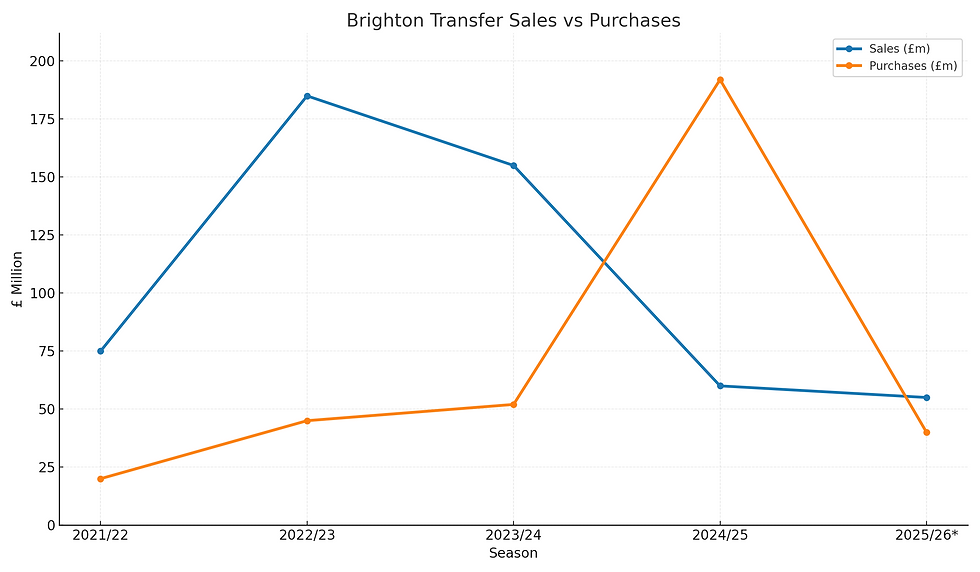
The Selling Cycle: Sell High, Replace Lower, Keep the XI Intact
As I discussed above, Brighton emphasizes roles when recruiting players. They follow the same approach when it comes to selling players.
They price the role, not the name/player hype.
Brighton’s exits are role-led. They sell when the market is overpaying for specific outputs (e.g., press resistance, high tempo ball winning, chance creation), not for reputation. This approach allows them to bank peak value for a particular player as opposed to selling them at a different point in time.
Player sales usually follow a clear proof of concept season: the player’s outputs are Premier League validated, the buying club’s need is urgent, and Brighton already have the successor in the building. If two of those three are missing, they tend to wait.
Using Carlos Baleba as a case study, his outputs are Premier League validated and Manchester United’s need for a midfielder that fits his profile and role is urgent. However, Brighton currently do not have a ready-made replacement (that I know of) for Baleba. I believe this has directly contributed to the increase in the player’s valuation as Brighton have most likely included the replacement risk as part of their valuation for Baleba.
The buy low/sell high table illustrates how Brighton consistently captures value and recycles it into the next wave of talent.

Sporting Risk:
This approach has allowed Brighton to post record-breaking profitability numbers such as an after-tax profit of £122.8m in the 2022/23 season (the highest ever by an English club) and a further £73.3m profit announced last season.
However, despite the incredible financial success, the league results haven’t marched in step. After a peak finish of 6th in the 2022/23 season, results dropped before recovering to the edge of Europe.
Heavy sale windows carry a sporting cost i.e., removing multiple starters disrupts the automatisms that underpin pressing, rest defence spacing, and set pieces, creating a short-term settling-in period where xGA (expected goals against) ticks up and build-up reliability wobbles. That’s the “settling in cost” of a high-churn transfer model.

The uncomfortable counterfactual is that if Brighton had held on to one or two of those peak value sales for an extra season, would that have translated to a better league position and European qualification?
There is a decent case to be made here. Keeping a Caicedo or Mac Allister level starter typically buys you continuity in the starting XI’s spine (pressing timings, set piece strategies, etc.) and a few extra league points via fewer “learning games” for replacement players. Even modest, that edge matters. 4 to 8 additional points over the course of a season often swings you two league places and flips you into or out of European qualification. Retention also avoids the integration tax that arrives when a new player has to learn the press and build-up patterns on the fly, precisely where Brighton’s post-sale dips have shown up.
Conclusion:
Brighton’s strength is timing. They buy early, sell when prices are at their highest, and try to slot replacements in quickly. The money shows it works, but results can dip while new players settle. In some seasons it may be smarter to keep one key player for another year, even if it means a smaller transfer fee down the line. Because a few extra points gained by keeping that player can be the difference between a mid-table finish and European qualification. With Baleba (and whoever’s next), the question remains: is the cash today worth more than the points you would have by keeping him?

Comments